Supported Lattices
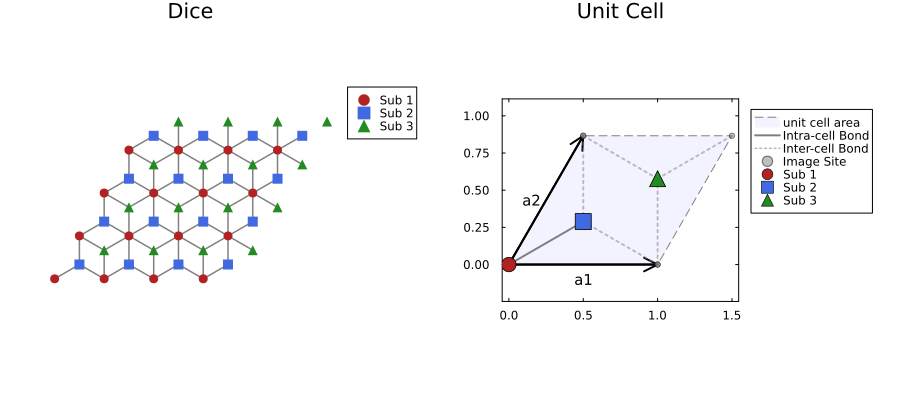
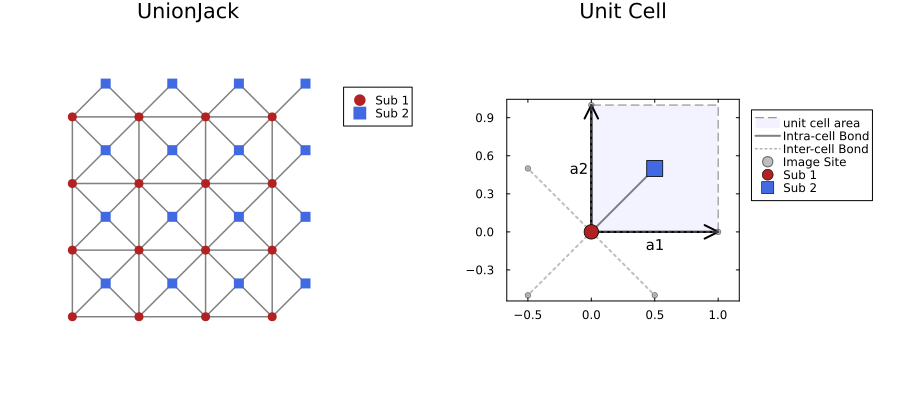
Lattices.jl provides lattices showed below. In each figure, left side shows lattice shape, and right side shows definition of unit cells.
Square lattice
The most fundamental 2D bipartite lattice with coordination number $z=4$. It has a single site per unit cell and does not exhibit geometric frustration. Often used as a standard benchmark for 2D quantum many-body algorithms. 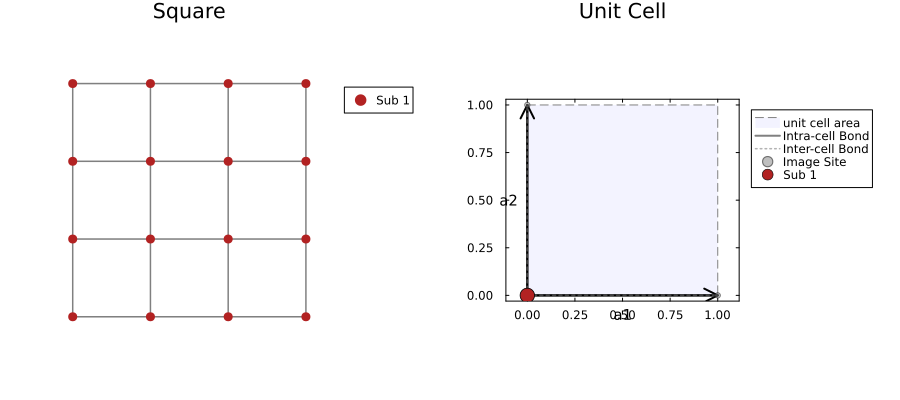
Triangular lattice
A lattice consisting of equilateral triangles with coordination number $z=6$. It is a prototypical example of a geometrically frustrated lattice (non-bipartite), famous for the $120^\circ$ magnetic order in the Heisenberg model. 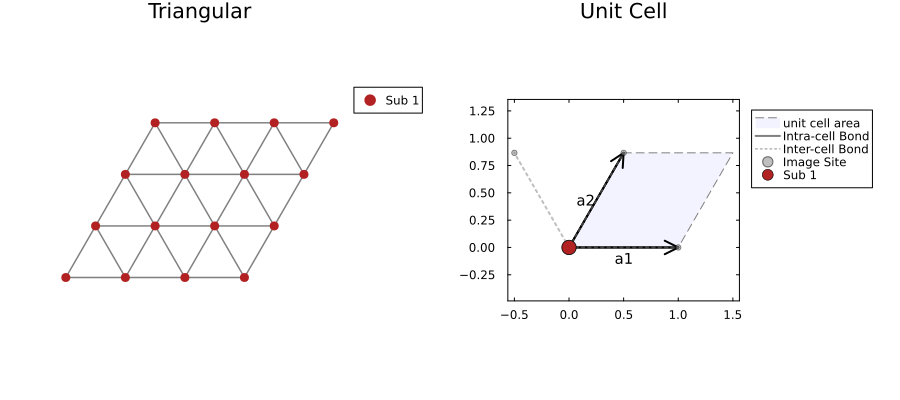
Honeycomb lattice
A hexagonal lattice structure found in Graphene. It is a bipartite lattice with coordination number $z=3$ and contains 2 sites (sublattices A and B) in the unit cell. 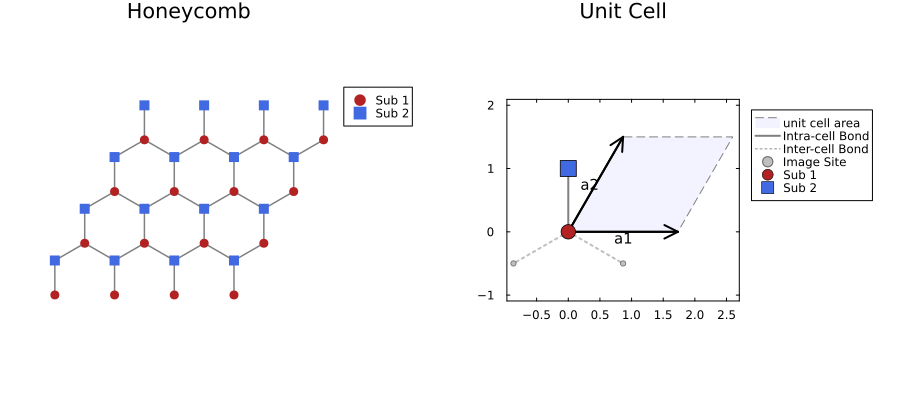
Kagome lattice
A lattice consisting of corner-sharing triangles with coordination number $z=4$. It contains 3 sites in the unit cell. Known for strong geometric frustration and as a candidate host for Quantum Spin Liquids (QSL). 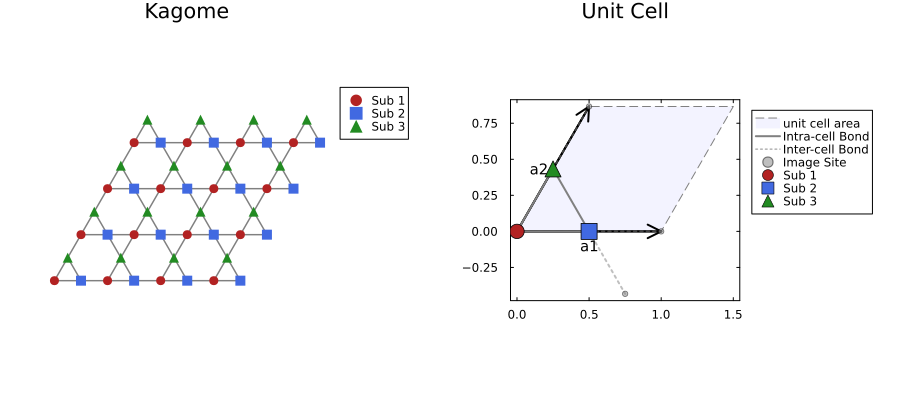
Lieb lattice
A lattice formed by removing the center sites from a $2 \times 2$ cluster of the square lattice, or decorating the edges of a square lattice. It is a bipartite lattice characterized by a flat band in its energy spectrum and ferrimagnetic ground states (Lieb's theorem). 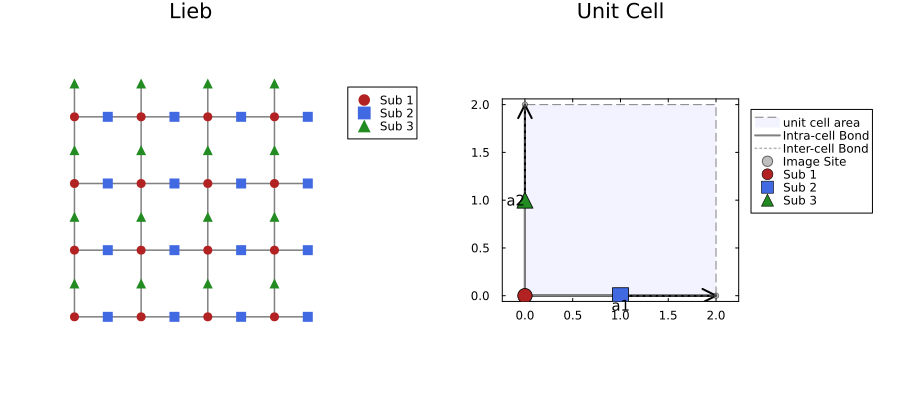
Shastry-Sutherland lattice
A square lattice with additional orthogonal diagonal bonds (dimers). It is geometrically frustrated and realized in the material $\text{SrCu}_2(\text{BO}_3)_2$. The model is famous for having an exact dimer-singlet ground state in a certain parameter region. 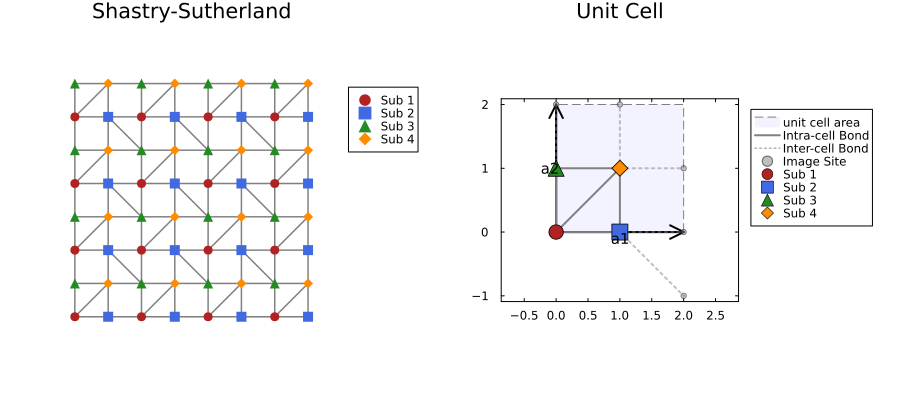
Dice lattice
A bipartite lattice that is the dual of the Kagome lattice. It contains 3 sites per unit cell, separated into a single 6-coordinated site ("hub") and two 3-coordinated sites ("rims").
Union Jack lattice
A square lattice with diagonal bonds added to alternating faces, visually resembling the Union Jack flag. It is a non-bipartite lattice with strong geometric frustration.
Geometric Features and Selections
Lattice2D.jl (via LatticeCore.jl) provides a geometric abstraction API for interacting with element locations, identifying spatial connectivity, and selecting parts of the lattice. Below are visualizations of how sites, bonds, and plaquettes are treated.
Site Specifications and Neighbors
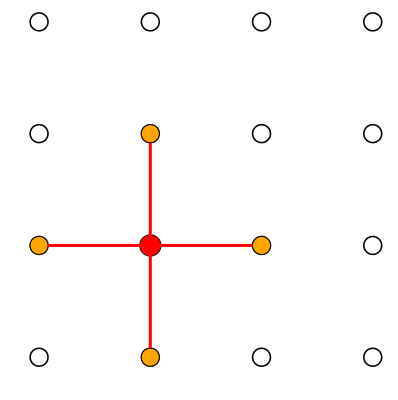
Sites in the lattice are mapped directly to physical coordinates (x, y). The neighbor API automatically determines connectivity based on the topological rules (or distance thresholds if Aperiodic).
Below, a central site is highlighted (red) alongside its immediate structural neighbors (orange) identified by neighbors(lattice, target_site).
Bond Specification
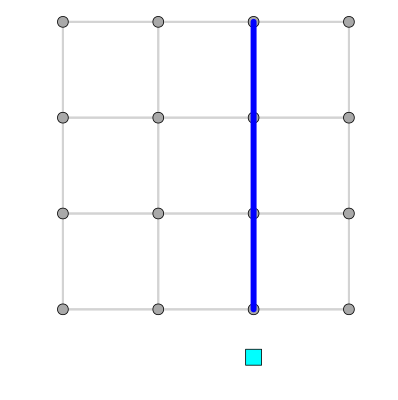
Bonds are stored as structurally directed edges between sites. Each bond can be accessed and manipulated individually, and we can query properties such as bond_center, allowing models to map variables directly to the edges of the lattice (e.g., lattice gauge theories or dimeric models).
Below, a specific bond is highlighted (blue) spanning from site i to site j, and its bond_center is marked in cyan.
Plaquette Specification
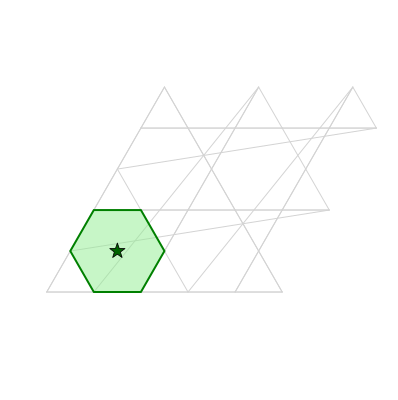
The API identifies elemental cycles or "faces" of the lattice, referred to as plaquettes. You can iterate through all plaquettes(lattice), picking out individual faces. Each plaquette has a center and an ordered list of vertices bounding the face.
Below, one plaquette from the Kagome lattice is selected and shaded (green), with its exact geometrical center marked.